Marietta Countertops offers countertop fabrication in Marietta and nearby towns. Fabrication turns a chosen countertop slab into a surface made for your exact layout. Accurate planning matters because cabinets, walls, appliances, and cutouts all affect the finished fit.
Marietta Countertops can connect you with local professionals who coordinate the details before installation.
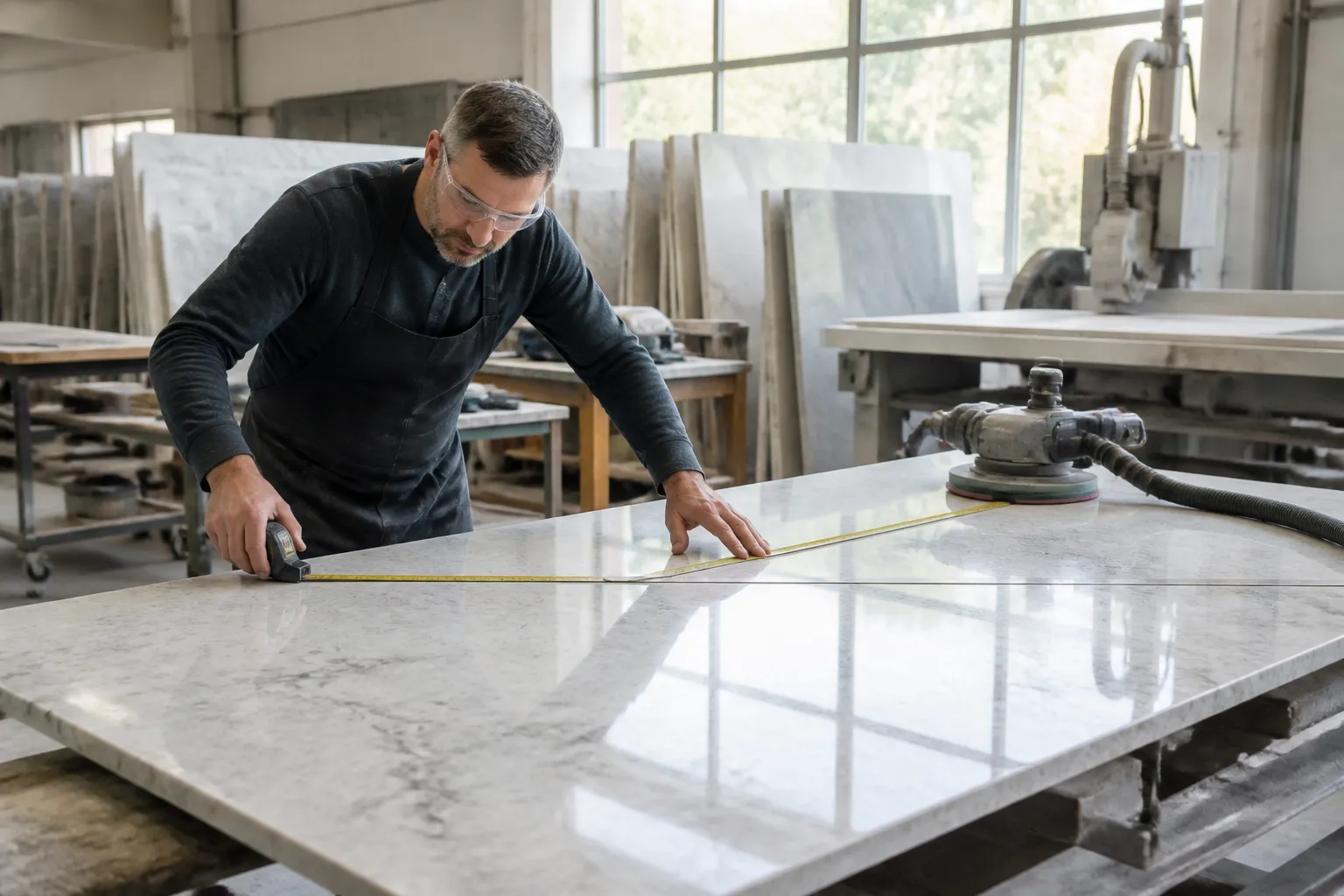
Fabrication is the shop work that turns a raw slab into your finished countertop. It covers measuring, layout, cutting, edge shaping, cut-outs, and polishing. Good fabrication is what makes seams tight, edges smooth, and sinks fit perfectly.
After your cabinets are installed, a fabricator measures them. Many shops use digital templating tools for precise measurements. The template captures every wall angle and corner, since few walls are perfectly straight.
The template is placed over the slab. This step decides where veins and patterns fall and where any seams will go. For natural stone with strong movement, ask to approve the layout.
Shops cut slabs with saws and computer-guided machines. Water is used to keep dust down and the blade cool.
The edge profile you picked is shaped and polished. Cut-outs are made for the sink, cooktop, faucet, and sometimes outlets.
Before install, pieces are checked for fit, finish, and any flaws in the slab.
Cutting engineered stone and some natural stone creates silica dust, which is a known health risk for workers. Reputable shops use water cutting, dust controls, and protective gear. It is fair to ask a fabricator how they control dust.
Timing depends on the shop’s schedule, the slab, and the design. Simple jobs move faster than large islands with waterfall ends. Ask for an estimated timeline from templating to install so you can plan your kitchen downtime.
Have cabinets installed and level. Choose your sink, faucet, and cooktop and bring their specs. Decide on edges and backsplash height before templating.
Slabs come in set sizes, so long runs and large islands often need seams. A skilled fabricator plans seams where they are least visible, such as near a sink or cooktop, and avoids them on overhangs. The two pieces are joined with a color-matched adhesive, then leveled so the surface feels flat. On patterned stone, the fabricator tries to line up veins across the joint.
An eased edge has slightly softened corners and a clean, modern look. A bullnose edge is fully rounded. A bevel edge has an angled cut on top. An ogee edge has an S-shaped curve for a traditional feel. A mitered edge makes a thin slab look thick. Simpler edges cost less and chip less often.
Asking to review the layout and checking photos of past work helps you avoid these issues.
Ask each shop to list the slab, fabrication, edges, and removal on separate lines.
After cabinets are installed and level, and after you choose your sink and cooktop.
Yes, and it is a good idea for natural stone with strong veining.
Ask about templating, seam placement, edge options, dust control, timeline, and warranty.
Start Your Project
Share a few details about your space, your preferred material, and your project goals. We will help you take the next step toward a countertop solution that fits your home and style.