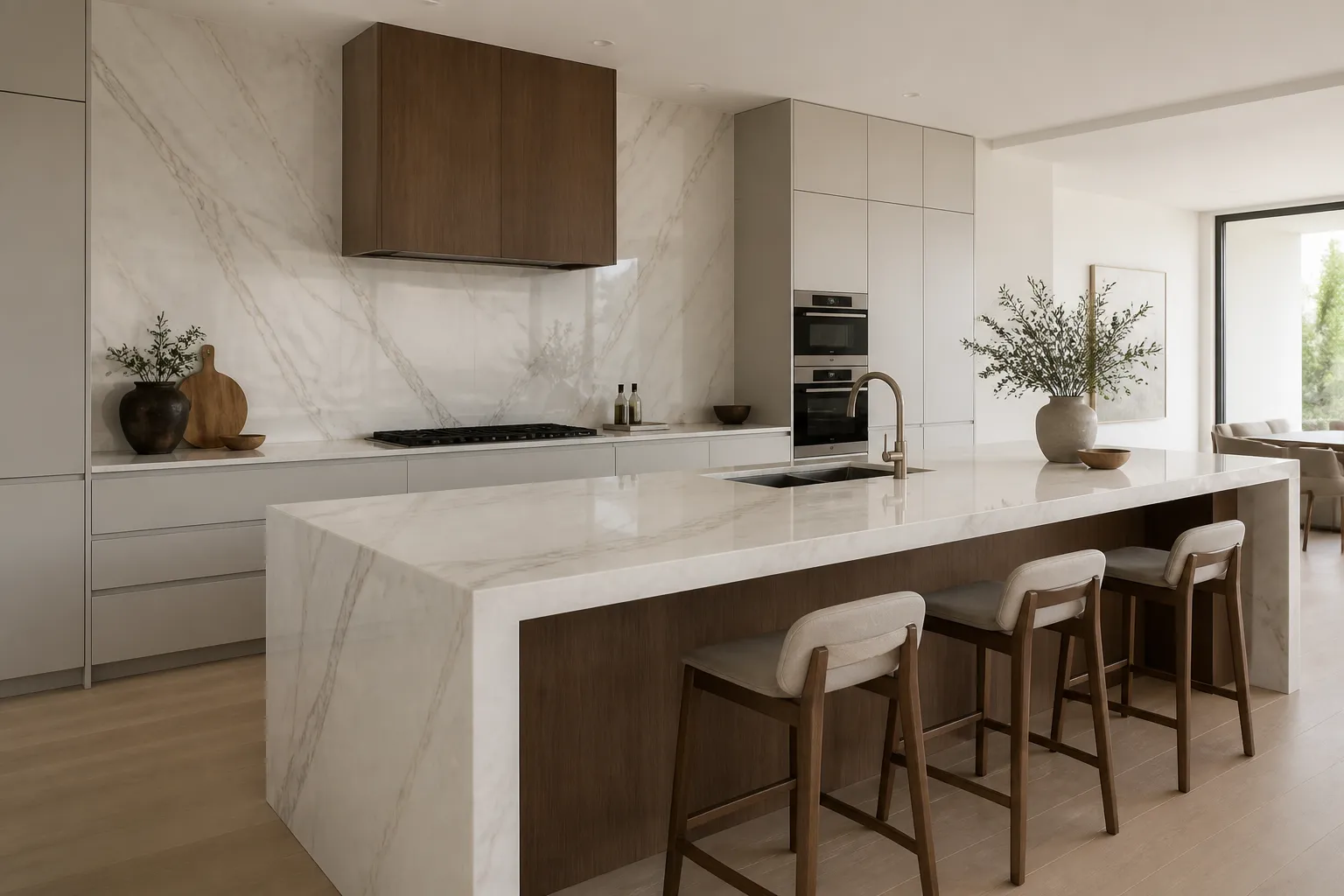
Marietta Countertops offers porcelain countertops in Marietta and nearby towns. Porcelain countertops offer a distinctive slab look for homeowners considering a sleek surface with coordinated applications. Pattern, thickness, edge treatment, and installation details affect the finished design.
Marietta Countertops connects local homeowners with countertop professionals who can help compare porcelain with other material choices.
Porcelain countertops are large, thin slabs made from fine clay and minerals fired at very high heat. The result is a dense, hard surface. Many slabs are printed to look like marble, concrete, or stone, so you can get a marble look without marble’s upkeep.
Porcelain slabs are often thinner than granite or quartz. That gives a sleek, modern profile, but it also changes how the slab is cut, handled, and installed.
Porcelain is hard, but it can chip if a heavy pot hits an edge. Because many slabs have a printed pattern on top, a deep chip may show a different color underneath. Some products have a pattern that runs through the body, which hides chips better. Ask which kind you are looking at.
Porcelain also takes skill to fabricate. The slabs are large and thin, so they need careful handling and the right tools. Not every shop works with it. Ask how many porcelain jobs the fabricator has done and where you can see one.
Thin slabs often use a mitered edge, where a second strip is joined at a 45-degree angle to make the edge look thicker. This hides the thin profile and gives a solid look. Simple square edges are common too. Very rounded or detailed edges are harder with porcelain, so the style options are smaller than with granite.
Its slim look and clean patterns suit modern and minimalist designs.
Because many products resist fading, porcelain is often chosen for sunny kitchens and sunrooms.
The same slab can run up the wall as a full backsplash, giving one continuous pattern.
Quartz is thicker and more forgiving on edges. Porcelain handles heat and sunlight better. Quartz offers more edge styles. Porcelain offers very large, realistic stone patterns. If you cook with a lot of heat and want a modern look, porcelain is worth a close look. If you want something forgiving and widely available, quartz is often the easier pick.
Choose your slab early, since pattern and size affect the layout. Ask the fabricator to show where seams will fall and how the pattern will flow across them. Confirm who handles the sink and cooktop cut-outs, and what happens if a slab cracks during fabrication.
Daily care is simple. Wipe the surface with warm water and mild soap. Most stains lift off easily because liquids do not soak in. Avoid hitting edges with heavy pots, since that is where chips usually start. Cutting boards protect your knives as much as the counter, since porcelain is very hard.
Look at full slabs, not just small samples. Large patterns can look very different across a whole island. Ask whether the pattern runs through the body or only on the surface.
We have not found a reliable national price for this material on Angi, so we will not guess. These install costs apply to most countertop jobs.
A written quote should name the slab, the edge, the thickness, and who handles plumbing.
Most porcelain does not. Check the care guide for the exact product you choose.
Yes, mainly on edges if hit hard. A mitered or slightly eased edge can help.
Porcelain handles heat well. A trivet is still a good habit.
Start Your Project
Share a few details about your space, your preferred material, and your project goals. We will help you take the next step toward a countertop solution that fits your home and style.