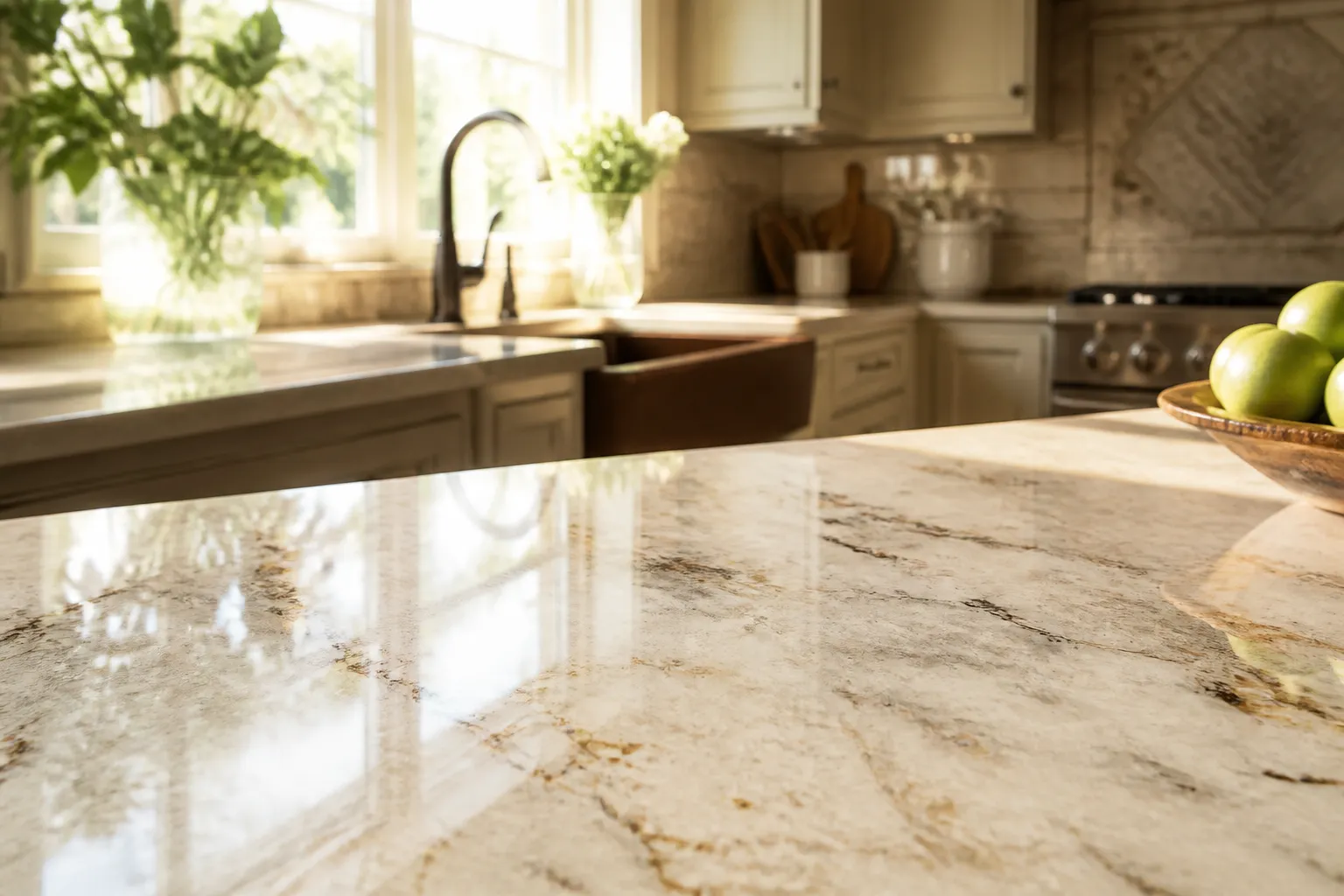
Marietta Countertops handles countertop refinishing for homes and businesses in Marietta and across Cobb County. A countertop that has lost its finish or no longer suits the room may not always need a full replacement. Refinishing can be a useful conversation for eligible surfaces and project goals.
Marietta Countertops connects Marietta homeowners with experienced countertop professionals who can review the condition and available options.
Refinishing restores the surface you already have. Instead of covering the counter with a new layer, refinishing brings back its original look. For natural stone, that can mean cleaning, honing, polishing, and resealing. For solid surface, it often means sanding out scratches and buffing.
Granite usually needs a deep clean and a fresh coat of sealer. Polishing can bring back shine in worn areas. Small chips can often be filled with a color-matched resin.
Marble etches when acids like lemon or vinegar touch it. Light etching can often be honed and polished out. Marble also needs regular sealing.
Quartz does not need sealing, but it can dull or chip. Small chips can be filled. Deep damage may need a section replaced.
Solid surface can be sanded and buffed to remove scratches. Because the color runs all the way through, the repair blends in well.
Refinishing keeps the original material and brings it back to life. Resurfacing puts a new coating or overlay on top. If you like your counters and they are in good shape, refinishing is often the simpler path.
There is no single schedule. Busy kitchens may need attention more often. A simple water test can tell you when stone needs sealing: if water darkens the stone after a few minutes, it is time to reseal.
Use a pH-neutral cleaner made for your material. Wipe up acidic spills right away. Use cutting boards and trivets. Avoid bleach and harsh cleaners on natural stone.
A technician starts by checking the surface and testing how water soaks in. Next comes a deep clean to lift grease and old residue. Chips and pits are filled and smoothed. Dull areas are polished with special pads. Finally, natural stone gets a fresh coat of sealer. Most visits are short, and the counters can often be used again soon after, though sealers may need time to fully cure.
Some damage is too deep to fix. Large cracks, crumbling edges, or stone that has shifted on its base may need a new section or a full replacement. A good technician will tell you honestly when refinishing will not solve the problem.
Freshly sealed stone needs time for the sealer to cure. Follow the technician’s guidance before setting down wet items or cleaning with anything stronger than water. After that, a gentle daily routine keeps the finish looking new. Use coasters under glasses, trivets under hot pans, and boards for cutting. Test the sealer with a few drops of water every few months so you know when to call for the next refresh.
Material grade, slab count, and cut-outs move the price most. An in-home measure turns these ranges into a real number.
Often, yes. Polishing can reduce wear marks, and chips can be filled.
Light etching can often be honed and polished out. Deep etching may need more work.
Drip some water on it. If the stone darkens within a few minutes, it is time to reseal.

Start Your Project
Share a few details about your space, your preferred material, and your project goals. We will help you take the next step toward a countertop solution that fits your home and style.